
Work orders, feedback, and journeys on dependable data
The challenge they faced
As a regional cleaning and restoration services firm, the team operated with disconnected systems that didn't reflect how their business actually worked. Their data was fragmented across multiple platforms, making it difficult to track work orders, customer feedback, and sales opportunities in a unified way. This fragmentation created inefficiencies in their operations and limited their ability to automate core business processes or extract meaningful insights from customer interactions.
The strategy we mapped
We started by establishing a clear data architecture and integration strategy, since the client's disconnected systems and fragmented data made it impossible to automate any meaningful workflows. We mapped out a Salesforce-to-HubSpot integration as the backbone, defined custom objects to track work orders and feedback separately from standard CRM entities, and sequenced the work to clean and validate mappings before sync went live. This ensured that downstream automation–surveys, nurture journeys, and targeting logic–would have reliable data to work with from day one.
The biggest constraint was data quality: Salesforce had inconsistent required fields, stale picklist values, and missing emails that blocked sync initially. We tackled this head-on by auditing the mapping sheet line by line, removing deprecated fields, and aligning the client's team on which fields were truly needed. Once sync was enabled and monitored closely, we built the marketing automation in phases, starting with a simplified subscriber journey and residential NPS survey while we resolved ongoing sync stability issues and refined triggering logic.
The solutions we executed
Secure email infrastructure and subscriber management: we set up DKIM authentication and DNS records for the client's sending domain, configured five custom subscription types so their audience could self-segment by interest (Cleaning, Restoration, and Commercial work), and created segments to manage marketing contact tiers and keep cost under control as the database grew from the Salesforce import.
We built three custom objects–Work Orders, Work Order Line Items, and Feedback–with up to 50 properties each to mirror the client's operational data and enable automation. Work Orders track every residential cleaning and restoration job; Feedback records capture NPS survey responses with associated scores and service line so the team could route insights by department and trigger follow-up actions. These objects synced reliably with Salesforce custom objects once we resolved initial rate-limiting and field-mapping issues.
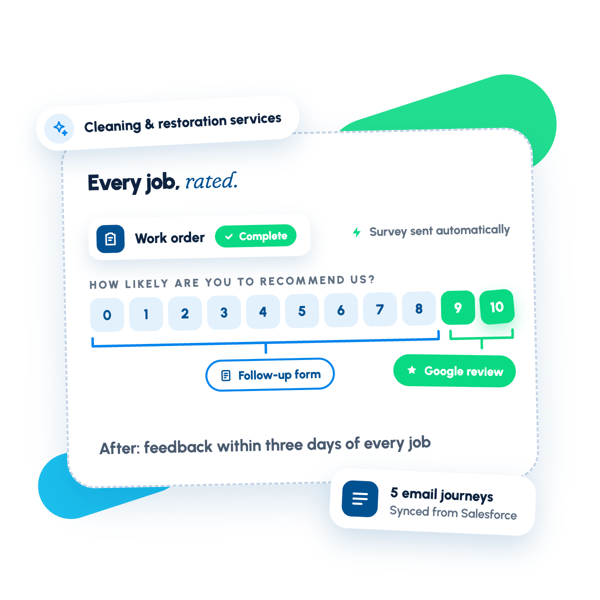
We set up six NPS survey workflows (one per service line–Residential In-Home Cleaning, Commercial, and others) that triggered automatically when a work order was marked complete, ensuring fresh customer feedback within three days. Each survey included smart routing: scores of zero to eight directed to a follow-up form to capture details, while scores of nine to ten directed straight to Google Reviews. The workflows auto-populated feedback records in HubSpot and mapped results back to Salesforce so operational teams could act on them.
We built five automated email journeys using HubSpot's workflow engine: a Subscriber Journey for nurture and content delivery, a New Customer Journey to onboard first-time clients, a Revive Journey to re-engage inactive households, and a Cross-Sell Journey to introduce complementary services. A simplified Subscriber Journey launched first while we resolved work order data sync delays; others staged for activation once cleaning and restoration status data flowed reliably. Each journey included branching logic, email sequences of three to twelve messages, and built-in delays to avoid bombarding customers.
We built a centralized reporting dashboard with fifteen custom reports tracking marketing funnel performance, campaign influence on revenue, contact volumes by segment, and journey engagement rates. We then trained the team with a live sixty-minute workshop on how to monitor these metrics and maintain HubSpot going forward. We also created an evergreen SOP manual with step-by-step instructions and short video clips so the team could reference how to run campaigns, update contacts, and troubleshoot common tasks without waiting for support.
What changed after the engagement.
The team now has a clean, integrated CRM foundation where work orders, customer feedback, and marketing contacts flow reliably from Salesforce to HubSpot. Custom objects track residential and commercial jobs alongside NPS survey responses, enabling automated workflows that route insights by service line and trigger follow-up actions within days. Six NPS survey workflows fire automatically when work is marked complete, capturing fresh feedback with smart routing that directs detractors to detail forms and promoters to Google Reviews.
Five email journeys–including onboarding, re-engagement, and cross-sell flows–now run on dependable data, supported by centralized reporting that tracks marketing performance and contact segments. The team can monitor sync health, manage marketing contact costs, and maintain campaigns through documented playbooks and ad hoc office hours support.
Want results like these?
Tell us where your revenue engine is stuck — we'll map the fix in one call.