
Salesforce-to-HubSpot sync with email activity logging
The challenge they faced
An composite roofing tile manufacturer, the team had been operating with legacy marketing technology that created operational friction. Their existing platform imposed heavy technical requirements, slowed campaign execution, and lacked the integration capabilities needed to connect marketing and sales data. With a platform renewal deadline approaching, the client needed to move to a more flexible solution that would reduce complexity and enable faster go-to-market cycles.
The team turned to Bluleadz to manage the transition to a modern platform, migrate their substantial existing contact database, rebuild critical segmentation and automation workflows, and train staff on new tools and processes. The goal was to achieve operational efficiency within a defined timeframe while maintaining continuity of their marketing programs.
The strategy we mapped
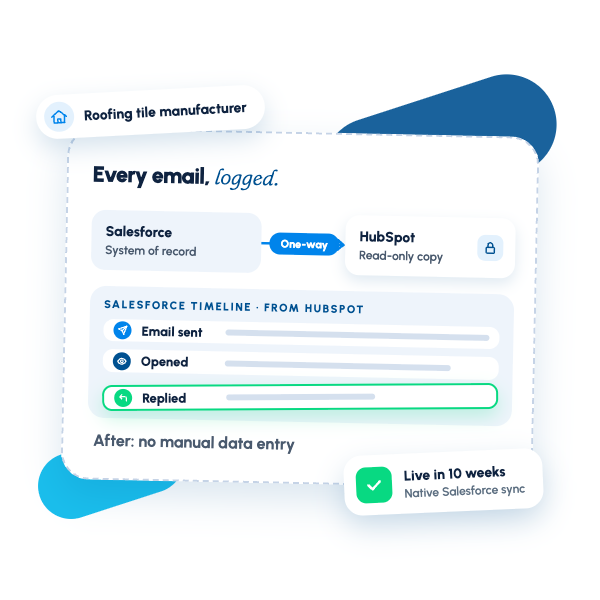
We prioritized the integration architecture and field strategy before building in sandbox. Salesforce was established as the system of record, with HubSpot consuming read-only copies of contact and account data through a listener-based sync triggered by record changes. The scope was constrained to support like-for-like email campaigns and nurture workflows by the Pardot sunset deadline, deferring more complex write-back scenarios. This decision shaped the rest of the work: we simplified the field set by deprecating unused fields, aligned picklists and multi-select values across both platforms, and locked down permissions to prevent unintended data writes from HubSpot to Salesforce.
Testing began in sandbox with identity and association corrections to ensure the embedded HubSpot component rendered consistently on Leads and Contacts. We worked through data backfill challenges, including deciding whether to import historical Account Engagement activity into HubSpot or preserve it in Salesforce custom objects, and validating that deduplication logic would prevent duplicate records when HubSpot backfilled missed data after platform downtime. A staged approach to production rollout was planned: seeding roughly 1,000 records per object initially, validating sync logs and behavior, then progressively backfilling the full contact database while monitoring Salesforce API consumption.
The solutions we executed
Field mapping and data architecture. We aligned Salesforce picklists and multi-select fields with HubSpot, configured a lean canonical field set by deprecating unused fields, and set field directionality to read-only in HubSpot except for opt-out data and exit-survey responses. Salesforce remained the system of record; HubSpot received a one-way sync of contact, account, and deal information, reducing data-integrity risk and eliminating the need for complex write-back logic.
Integration configuration and testing. We configured the native Salesforce integration with listener-based sync, established ownership rules (including 'always use Salesforce' for Deal Owner), and locked down permissions so HubSpot administrators could not modify restricted fields or associations. Testing covered activity logging to ensure email events from HubSpot campaigns appeared correctly in Salesforce timelines, Lead-to-Contact conversion behavior, and deduplication scenarios. We validated that the HubSpot engagement history component embedded in Salesforce would display activities consistently, working through initial configuration constraints and settling on a filtered view showing email sends, opens, and replies to minimize clutter.
Production migration and data backfill. We planned a controlled, staged rollout to production with initial seeding of roughly 1,000 records per object to validate behavior, then progressive backfill of the remaining contact database using CSV import rather than API-based methods to avoid Salesforce rate-limit paywalls. Field mapping and permission configurations were validated to match sandbox before cutover, and a temporary increase in Salesforce API limits was requested to manage the seeding workload. The team monitored outbound sync toggles and developed safeguards on opt-out edits to prevent workflows from cascading unintended changes to Salesforce.
What changed after the engagement.
The client's Salesforce instance now serves as the system of record with HubSpot consuming read-only contact, account, and deal data through a listener-based sync. This architecture eliminates manual data entry, reduces integrity risk, and enables marketing to run email campaigns and nurture workflows from HubSpot while maintaining a single source of truth in Salesforce. Activity logging now flows bidirectionally for email engagements, with the embedded HubSpot component in Salesforce displaying campaign sends, opens, and replies for sales visibility.
Want results like these?
Tell us where your revenue engine is stuck — we'll map the fix in one call.