
Practice onboarding tracked across four care pillars
The challenge they faced
A digital health platform providing clinical intelligence and care management solutions to healthcare networks and payers was managing client implementations and ongoing engagements across multiple internal teams using disconnected systems. The value-based care team tracked spreadsheets and lacked a centralized communication hub, creating inefficiencies in how they coordinated with client practices and reported on service adoption. The delegated services team relied on spreadsheets for client data and service level agreements while using a separate ticketing system, making it difficult to provide clients with a unified view of their account status during calls. Without integrated workflows, the team could not automate implementation task creation or track milestone completion across dozens of practices.
The organization needed a system that would allow different teams to view relevant client information without disrupting existing workflows, while automating the handoff between implementation and ongoing maintenance phases. A flexible data architecture was critical, as the company anticipated service overlap between teams within months. The team brought Bluleadz in to build a centralized HubSpot environment that could handle complex client hierarchies, integrate with existing systems, and provide the visibility each team needed to serve clients effectively.
The strategy we mapped
We sequenced discovery and strategy before build to ensure workflows reflected operational reality across two distinct teams. The Value-Based Care and Delegated Services teams tracked client implementations and service delivery through separate processes; consolidating them into one HubSpot environment required settling the data architecture first. We audited both teams' entry points, milestones, and reporting needs, then designed parent-child structures to link practices to networks, and projects to practices across multiple pipelines.
The key constraint was data governance: team members weren't HubSpot users and assignments lived in free text; we mirrored role fields from projects to practice records as read-only to maintain a single source of truth while preserving existing workflows. Once the structure was locked, we built automation to hand off practices from implementation to ongoing management, then configured reports that surfaced the same data to each team's role.
The solutions we executed
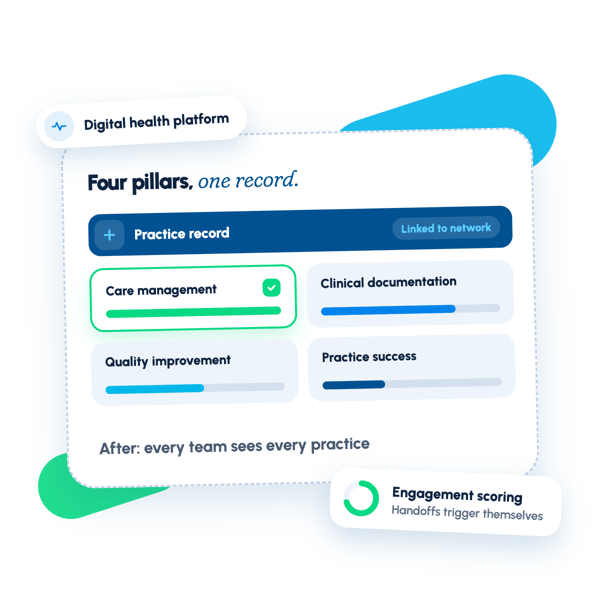
We configured two Service Hub pipelines for the Value-Based Care team to track practice implementation across four pillars–Care Management, Clinical Documentation Integrity, Quality Improvement, and Practice Success–with parent-child project links so each practice's progress across all pillars appeared on a single company record. A third pipeline for the Delegated Services team integrated Jira tickets using the HubSpot native integration, syncing assignee and owner fields so team members could work tickets in either system while maintaining visibility of open items and their service level agreements on the client company record.
We set up assignment fields for each role–CDI Specialist, RN Case Manager, Health Guide, and Quality team–as read-only mirrors on practice records, fed from the source projects, so the team could filter their daily work by name without creating duplicate editable fields. We created custom permission sets aligned to team structure and designed saved views for each role, enabling practice-specific workflows while keeping cross-team visibility where required for client calls and reporting.
We built an engagement scoring system that qualified practices based on defined criteria and routed notifications to assigned team members when scores changed, automating the handoff between implementation and ongoing service phases without manual escalation.
We constructed separate dashboards for the Value-Based Care and Delegated Services teams, featuring up to 15 custom reports on each. These included practice status and implementation progress by pillar; meeting ownership, type, and overdue tracking at the practice level; attributed member counts by payer; and Delegated Services ticket volume and closure time. We addressed data consolidation challenges–such as practices appearing multiple times per report when tracked across four pipelines–through filtering and embedding status fields at the company level where possible.
We documented step-by-step workflows for logging emails via the Outlook extension, creating and assigning tasks, and using the @mention feature to replace informal chat, ensuring both teams moved off spreadsheets and into a unified source of truth. Training covered navigation, record associations, report building, and the mandate to log all new client activity in HubSpot from go-live forward, with a two-week reconciliation period to migrate historical data.
What changed after the engagement.
The client now has a centralized HubSpot environment that consolidates practice implementation and ongoing service delivery across multiple teams into a single source of truth. Two distinct teams–Value-Based Care and Delegated Services–can view relevant client information without disrupting existing workflows, with automated handoffs between implementation and ongoing maintenance phases, objective engagement scoring, and unified dashboards providing visibility into practice status, service adoption, and team performance across dozens of practices and networks.
Want results like these?
Tell us where your revenue engine is stuck — we'll map the fix in one call.