
Marketing operations consolidation for a distributor
The challenge they faced
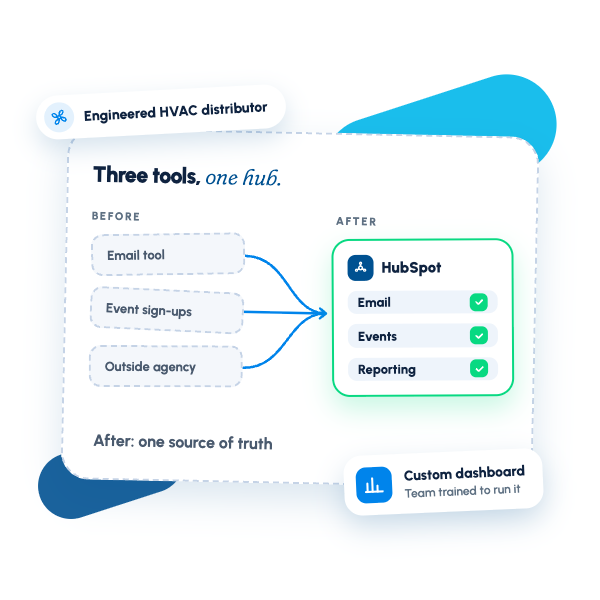
An engineered HVAC solutions distributor was managing marketing operations across multiple disconnected platforms: email marketing through one tool, event registration through another, and support from a third-party marketing firm. The fragmented toolset created manual work, limited visibility into customer engagement across channels, and made it difficult to track how prospects moved through the sales pipeline. The team needed to centralize their marketing operations and establish a clearer, data-driven path to measure campaign performance and event participation.
The strategy we mapped
The team needed to unify their marketing technology and establish a structured approach to lead conversion, so we sequenced the work in stages that built toward full campaign capability. First, we set up the foundational Marketing Hub environment–connecting domains, integrating third-party tools, and preparing the infrastructure. Once that foundation was solid, we imported and architected the contact database, defining data properties and automation rules that would turn raw records into a working lead-conversion system.
With the database ready, we then built the email delivery layer and configured workflows that would power multi-channel activation. Only after these building blocks were in place did we launch the first campaign, which gave the team a working model for future sends. Throughout, we planned for the team to own and operate what we built, so we embedded training and dashboards that would let them monitor performance and refine workflows without ongoing support.
The solutions we executed
We built out the Marketing Hub environment by installing tracking code, connecting the primary domain, configuring the global brand kit, setting up team calendars and email integrations, linking social and ad accounts, and connecting up to three native app integrations. We then imported the contact database into HubSpot, ensuring data was clean, formatted, and structured for automation. The data architecture work involved defining custom properties, recreating up to five existing website forms as native HubSpot assets, customizing record sidebars for Contacts, Companies, and Deals, and setting up optimized record-creation forms. We established the billable and non-billable contact segmentation with automated workflows, then architected the full Lifecycle Stage funnel with automation and active segment lists for each stage.
On the email side, we configured DKIM authentication for the sending domain, set up up to five custom subscription types with corresponding opt-out segments, and created one branded drag-and-drop template. We also demonstrated the foundational workflow triggers for internal and external email sends. For campaign activation, we created a parent Campaign to aggregate assets, set up and scheduled up to three marketing emails with layout, personalization, and testing, built the automated nurture workflow with if/then logic, and created an Active List to track the campaign audience.
We configured the Campaign Analytics view to show which assets drove performance. After a 60-minute training session covering workflows, property standards, and role-specific priorities, we handed over a custom reporting dashboard with up to 15 reports tracking primary marketing goals and two rounds of refinement to match leadership reporting preferences.
What changed after the engagement.
The client now has a unified marketing operations platform in HubSpot that consolidates email, event registration, and engagement tracking across multiple channels. Marketing and sales teams work from a single source of truth, with contacts organized by lifecycle stage, territory, and eligibility for campaigns. Workflows automate lead qualification and multi-channel nurture sequences, while dashboards track engagement and campaign performance by audience segment. The team can now execute campaigns, manage event registrations and follow-ups, and measure results without toggling between disconnected tools or manual spreadsheets.
Want results like these?
Tell us where your revenue engine is stuck — we'll map the fix in one call.