
Multi-year contracts split across fiscal years
The challenge they faced
The client operated with sales and customer data spread across multiple systems, lacking centralized visibility into their pipeline and forecasting. Manual processes consumed time and created friction between their sales operations and financial systems, slowing their ability to respond to customer needs and scale efficiently.
The strategy we mapped
We built the strategy around establishing clean data foundations and workflow automation to support a structured sales process. The first priority was mapping the client's existing sales approach–qualification stages, deal velocity touchpoints, and revenue attribution across multi-year contracts–into HubSpot's pipeline and deal mechanics. That clarity let us sequence the work: foundational setup of tracking and email integration happened in parallel with discovery of the sales process itself, while pipeline configuration, automation, and reporting built on what we learned. We also deferred quoting enablement slightly to focus training on core deal management first, letting the team find their rhythm before adding a net-new capability.
The solutions we executed
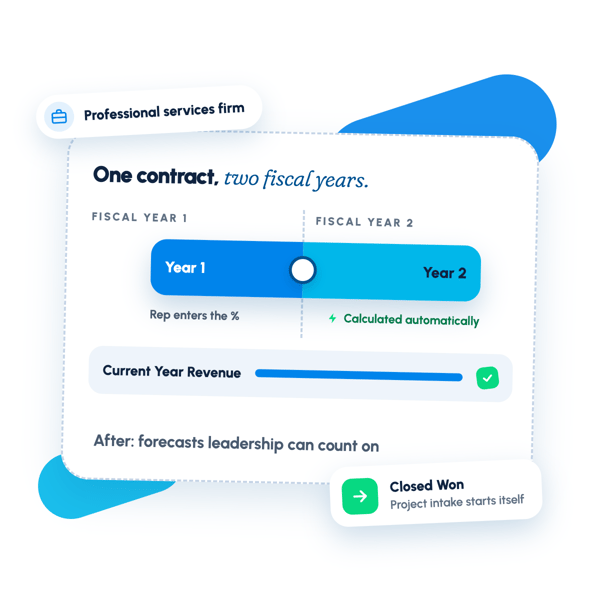
Deal pipeline with revenue architecture. We configured a deal pipeline aligned to the client's qualification stages–Decision Maker Engaged, Proposal Invited, and Closed Won–with stage-specific required fields to enforce data discipline. Because contracts often span fiscal years, we designed a revenue-weighting model using percentage-based allocation: sellers enter the portion of contract value attributable to Year 1, and the system calculates Year 2 automatically, feeding into a "Current Year Revenue" field for accurate forecasting regardless of deal start date. We also set up automated deal-to-project creation on Closed Won, triggering intake workflows that capture delivery details at project handoff.
Quote system with product catalog. We built out the HubSpot product library with category-based organization and SKU prefixes to keep the catalog navigable during line-item selection. The quote template was customized with the client's branding, standard terms attachments, and simplified display: internal users see quantity and billing detail for calculation, but clients see only services and total price. We configured quote automation to move deals to Closed Won upon signature, triggering downstream accounting and project workflows without redundant notifications.
Sales enablement and visibility. We created a centralized sales dashboard with up to 15 custom reports covering deal velocity, pipeline value by stage, rep activity, and product mix–tracking the metrics leadership needed to forecast and manage growth. Training documentation included step-by-step guides with short video clips showing how to create contacts, associate companies, build deals, and move them through stages. We also set up email and calendar integration so activity logs capture automatically, reducing manual data entry and keeping the pipeline current.
Data architecture and foundational infrastructure. We standardized how the client's data enters and lives in HubSpot: contact and company record layouts were customized to surface mission-critical fields while hiding clutter, required-field enforcement by pipeline stage ensured consistent data quality, and we installed tracking code to monitor website engagement and lead intent. A documented sales operations manual served as an evergreen reference for both veteran and new reps on core tasks–contact creation, company association, deal movement, and quote generation–ensuring consistent adoption as the team grew.
What changed after the engagement.
The client's sales team now operates through a unified, centralized pipeline that replaces scattered spreadsheets and manual processes. Customer and deal data are standardized across contact, company, and deal records, with email, calendar, and calling automatically tracked in the CRM. Required fields at key pipeline stages ensure clean data for accurate forecasting and reporting.
A percentage-based revenue model correctly attributes multi-year contracts to fiscal years, eliminating manual entry errors. When deals close, projects automatically launch with enforced intake capture, and quotes generate from consistent product catalogs and templates, streamlining the path from opportunity to contract.
The client now has actionable visibility into their sales performance through centralized reporting: stage conversion rates, pipeline velocity, rep activity, and quarterly revenue forecasts by owner and team are distributed automatically to leadership. An MQL-to-deal conversion report shows how qualified leads progress through the funnel. Standardized deal terminology aligned to internal language and clear stage gates have replaced the confusion of legacy systems, freeing the sales team to focus on moving deals forward rather than managing data.
Want results like these?
Tell us where your revenue engine is stuck — we'll map the fix in one call.