
Establishing authority in a vendor-dominated market
The challenge they faced
As a vendor-neutral network operation solutions provider, the team was struggling to establish itself as a credible alternative in a market dominated by established incumbent vendors. Their prospecting was manual and fragmented, lacking a unified approach to reaching and converting network architects, CTOs and operations leaders who were evaluating alternatives to traditional proprietary solutions. They needed to shift from reactive outreach to a scalable, data-driven revenue engine that could capture the growing opportunity in the market.
The strategy we mapped
The team needed to position itself as a consultative alternative in a market dominated by established vendors. We began by mapping the strategic landscape through customer discovery, conducting interviews across three core personas to understand their priorities, pain points and decision criteria. This research informed everything that followed.
Next we developed buyer personas that captured the distinct motivations of network architects, CTOs and operations leaders. We layered in keyword research to identify the gaps between how the team was being found and the language used by prospects evaluating alternatives to incumbent solutions. This gap analysis shaped the content strategy.
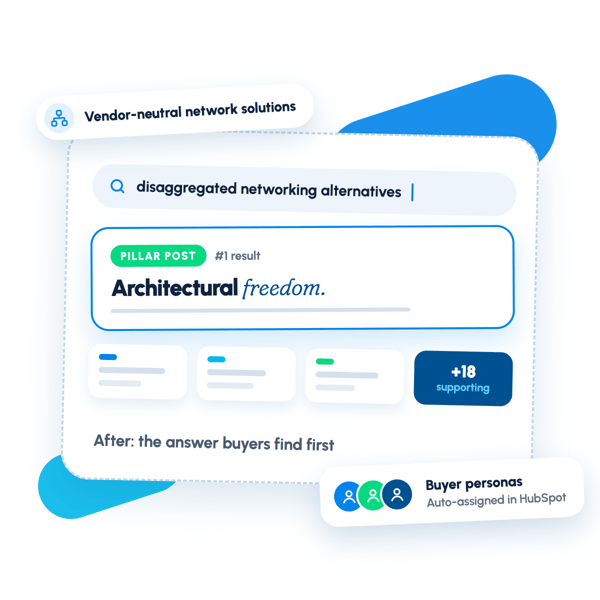
With that foundation in place, we designed a topic cluster architecture around the highest-ROI themes: architectural freedom, disaggregated networking, and the transition away from proprietary hardware. We then outlined the content needed to dominate those clusters, starting with two pillar posts that would serve as authoritative hubs, supported by 18 targeted posts addressing specific technical and business concerns. Finally, we set up ongoing managed services to execute the strategy, test it in market, and refine it based on performance.
The solutions we executed
We conducted six customer interviews across the three core personas to surface how they evaluated the team's offerings versus traditional OEMs, what they valued most, and where misconceptions existed. From this voice of the customer research, we developed three detailed buyer personas that captured their distinct technical and philosophical priorities. We then integrated those personas into HubSpot with automated logic to assign them to contacts based on engagement signals and form submission data, enabling more precise targeting in future campaigns.
We completed a keyword research and content gap analysis to identify high-intent technical queries where the team was underrepresented relative to competitors. This revealed strategic keyword opportunities around legacy hardware end-of-life cycles and compliance-driven procurement decisions. We used those findings to architect a topic cluster strategy focused on architectural freedom and disaggregated networking, the highest-ROI themes in the market.
We developed 20 detailed content outlines for blog posts, each informed by subject matter expertise and guided by the keyword research and customer interviews. We then wrote two pillar posts of approximately 3,000 words each, covering the primary topic clusters in depth and optimized for the most strategic keywords. We also created 18 supporting posts using a framework that blended AI-assisted first drafts with human expertise to add depth, original insights, internal and external links, optimized imagery, and proper topic cluster attribution within the HubSpot SEO tool.
We established a monthly managed services subscription providing ongoing strategy consultation, execution support, and performance alignment. This included a 60-minute discovery kickoff to set priorities, biweekly strategy sessions, and end-of-month reporting to track progress and refine the approach based on market performance.
What changed after the engagement.
The client now has a foundational content and SEO strategy fully operationalized in HubSpot. Buyer personas are auto-assigned to incoming contacts, a 30-topic cluster plan with prioritized keywords guides content creation, and a comprehensive pillar post anchored by eighteen supporting blog outlines provide the structure for sustained organic visibility. Content production is underway with published posts, and the team has clear direction on what to write and why, enabling consistent execution toward search rankings and buyer engagement.
Want results like these?
Tell us where your revenue engine is stuck — we'll map the fix in one call.