
End-to-end visibility across sales and implementation
The challenge they faced
A medical device manufacturer providing pressure injury prevention technology to hospitals and health systems, the team was managing sales pipeline and post-close implementation across two separate systems. Accounts, contacts and opportunities lived in a legacy CRM where parent and child relationships between health systems and individual hospitals were inconsistently tracked, while the 30-day clinical implementation process, quoting and expansion tracking ran through spreadsheets, documents and email. This fragmentation left leadership without visibility into the full customer journey from new logo to expansion, and manual processes consumed time the lean commercial team could not spare.
The legacy CRM contract was ending in November with only a month-to-month extension available, creating both urgency and cost pressure. Leadership set year-end as the hard deadline for migration to a new platform, leaving a compressed window to design and implement the new system while keeping operations running.
The strategy we mapped
We prioritized the quote template and sales pipeline architecture as the immediate deliverable to unblock quoting and demonstrate early progress, while the data migration and implementation tracking were run in parallel. The legacy CRM contract cutoff in November created urgency; we compressed the standard implementation timeline so that the platform could go live for day-one operations even as data cleanup and import validation continued. The health system-to-hospital parent-child structure was foundational to the data model, so we resolved that before importing the 21,000 contacts and 7,000+ accounts to avoid associations getting misaligned during the bulk load.
The solutions we executed
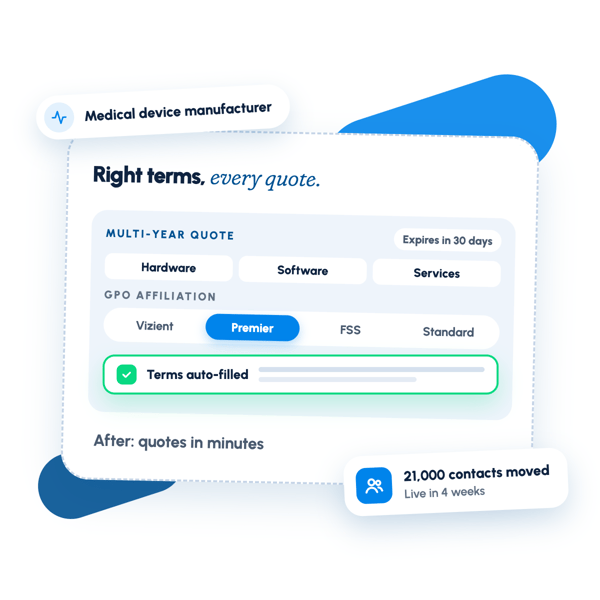
The quote template became the primary tool for accelerating deal velocity. We built a multi-year subscription bundle quote with dynamic personalization that automatically pulled deal information into the document, including hardware, software and services line items on a single comprehensive proposal. The template included annualized totals to clarify cost across different billing periods, conditional discount display so pricing stayed clean when no discounts were applied, and a dropdown-driven terms section that auto-populated language based on the customer's GPO affiliation–Vizient, Premier, FSS, or standard–so reps could generate governance-compliant quotes without manual editing. We included fields for optional evaluation agreements and set quote expiration to 30 days by default, with follow-up task reminders to keep proposals moving forward.
We engineered the core sales pipeline to move the team from a two-system workflow into one source of truth. The sales process mapped to six stages reflecting how the team actually sells: Qualification at 10% probability, Present Value Proposition at 50%, Alignment at 75%, Phase 1 Implementation at 90%, Committed Deployment, and Expansion. We added required properties as stage gates so opportunities couldn't advance without completing each step, and we built the pipeline to accommodate both initial deployments and follow-on expansions within the same deal record so account-level reporting could sum total revenue without duplication.
An Implementation panel on each deal tracked the 30-day clinical implementation cycle with a dropdown for implementation stage and a notes field, so spreadsheets and email threads could be replaced with structured deal-level tracking visible to both sales and the implementation team. Automation moved deals forward through stages as implementation milestones were hit, reducing manual status updates.
We imported 21,000 contacts, 7,000+ accounts and 920 health systems from Pipeliner with correct parent-child associations so that hospitals linked to their health system and every contact was associated to both. We created a custom Health System object to represent the multi-hospital networks that drive purchasing decisions, and built workflows that propagated the health system association down to contacts and opportunities so that anyone filtering by health system would see all relevant records. We reassigned ownership to active sellers so that Dan, Karen, Don and Colin owned accounts and contacts moved automatically to account owners, ensuring sales notifications worked without manual configuration.
Historical lead data was migrated as Lead records associated to accounts with notes preserved from the prior system, and we set up lead-to-account ownership to keep routing consistent. Lead association cards were configured to display on contact and account records so the team could see which contacts were new leads and track them through the first contact stage.
We set up foundational HubSpot infrastructure so sales could work on day one. Microsoft email and calendar connection synced existing communication history and allowed reps to log calls and meetings in HubSpot directly from Outlook. Tracking code was deployed on the website to begin capturing anonymous visitor behavior.
Email sending domain was configured with branded DNS so marketing campaigns would send from the company's own domain rather than HubSpot's shared IP, protecting sender reputation. Meeting scheduling integration allowed prospects to book calls without email back-and-forth.
Segments were built from imported contact properties–job title, conference attendance, and source–so marketing could immediately begin nurturing specific audiences. Active Lead, Sales and Implementation pipelines were ready with default views showing all opportunities by default, eliminating confusion from filtered views that could hide deals unexpectedly.
What changed after the engagement.
The sales pipeline now runs through one consistent system instead of spreadsheets and email. Sales can generate governance-compliant quotes in minutes with hardware, software and services line items, automatic cost totals across billing periods, and conditional GPO-specific terms that auto-populate based on customer affiliation. The 30-day clinical implementation cycle is tracked within each deal with structured stage dropdowns and notes, replacing fragmented spreadsheets and enabling automation that moves deals forward as milestones are hit.
Health system and hospital relationships are correctly modeled so that 21,000 contacts and 7,000+ accounts associate properly to both their hospital and parent health system, enabling account-level revenue reporting without duplication. Leadership now has visibility into the full customer journey from new logo through expansion.
Want results like these?
Tell us where your revenue engine is stuck — we'll map the fix in one call.