
Multi-configuration quoting and bulk pricing by configuration
The challenge they faced
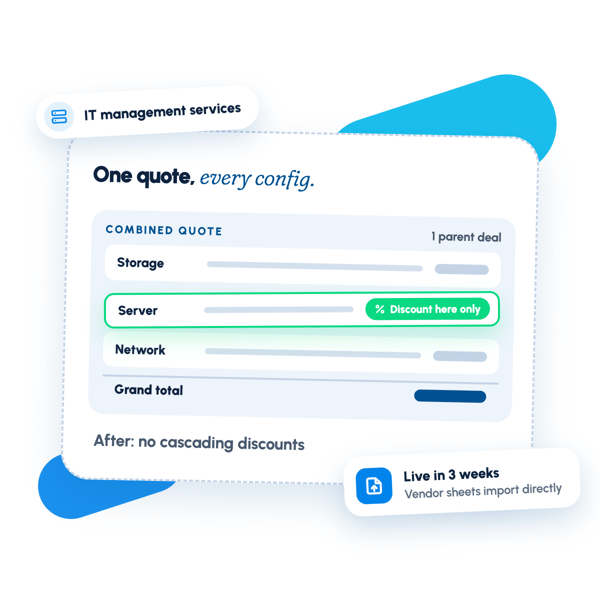
An IT management services provider delivering secure, reliable, and scalable IT infrastructure to businesses across on-premises, cloud, and hybrid environments, the team faced a fundamental constraint in HubSpot: the platform's native deal and quoting structure supported only a single set of line items and discount margin per opportunity. When sales reps quoted complex projects involving multiple configurations–storage, server, and network components–each with distinct pricing and margins, they had no way to present all three within one quote without the discount on one configuration incorrectly cascading to the others. This fragmentation forced reps to create separate deals for each configuration, which bloated the sales pipeline with incomplete records and made forecasting unreliable. The team recognized they needed a new data model and workflow but lacked clarity on how to build it, what guardrails to put in place, and how to adopt it without disrupting their sales process.
The strategy we mapped
We started by mapping the exact structure the team needed: how a single master deal would hold multiple configurations, how each configuration would be its own child deal linked back to the parent, and how quotes would render all configurations on one document while forecasting relied on the parent record only. This architecture–and the fields, associations, and workflow logic it required–was documented and approved before any build work began. The constraint was clear: HubSpot's native quoting system treats line items as a flat collection under one deal, with a single discount that cascades to all items. That meant we had to create a custom data model using configuration names as grouping keys, nested subtotals by configuration and product class, and targeted pricing automation that matched configuration names to apply discounts only to the lines in that group.
The team's line item import process was the second priority. Vendor quotes arrive as spreadsheets with dozens or hundreds of line items, sometimes spanning multiple configurations. Rather than require manual editing before import, we built a secure HubSpot-hosted upload form that accepts the raw export, parses it against the deal, shows a preview for review, and then replaces or appends line items based on the mode the rep selects. The form maps product classes (Hardware, Software, Support, Services) to consistent labels, preserves zero-dollar informational lines required by the client's factory integration, and keeps the configuration title intact so grouping survives the import.
The solutions we executed
The combined quote template groups line items under configuration headers with subtotals for each configuration and nested breakdowns by product class. Sales reps can control which columns appear (list price, discount, unit net, extended net), reorder them, and add detail rows–all through module settings without touching code. The quote automatically reflects the current state of the deal's line items, and a workflow regenerates it each time a child configuration changes.
Closing totals stack at the end: quote total, bulk discount, sales tax, shipping, other charges or credits, and grand total. A product breakout summary appears at the bottom totaling Hardware, Software, Support, and Services across all configurations at both list and sell price.
Bulk pricing and discounts now scope to individual configurations. A rep selects a configuration by name, enters a percentage or fixed discount, and our custom automation applies it only to line items in that group, leaving other configurations untouched. An adjustment log tracks what was changed and by how much.
The same logic supports margin adjustments for cost-based calculations. Configuration names are normalized during matching so minor variations don't break the targeting.
The import tool accepts raw vendor exports and maps them into a deal's line items without requiring spreadsheet prep. Reps upload the file, review which line items will be added, replaced, or deleted, and confirm. The tool supports add-only mode (for merging multiple quotes into one deal), full replacement, or targeted deletion.
Configuration titles and product class codes are preserved and mapped to HubSpot's standard labels. Zero-dollar lines for assembly or factory steps remain on the quote for information even though they carry no price.
We set up the infrastructure for the custom data model: a configuration name field on line items to group them, deal-level properties to track which configuration receives a pricing adjustment and to log adjustment history, custom objects or field structures to associate child configuration deals to a parent master deal, and permission sets to protect records maintained by sales operations. A master deal identifier and a field listing the sales order numbers of all child configurations ensure reps and forecasting systems see the relationship at a glance.
What changed after the engagement.
Sales reps now quote complex multi-configuration projects within a single deal and quote document instead of creating separate deals for each configuration. Configuration-specific pricing and discounts apply independently without cascading across unrelated line items. Line items import directly from vendor spreadsheets without manual editing, preserving configuration groupings and zero-dollar informational lines required by factory integration.
Quote templates render all configurations with nested subtotals by configuration and product class, while bulk pricing automation targets discounts to individual configurations by name. The sales pipeline is no longer fragmented by incomplete configuration records, and forecasting now relies on parent deal records only, making pipeline health and revenue projections dependable.
Want results like these?
Tell us where your revenue engine is stuck — we'll map the fix in one call.